
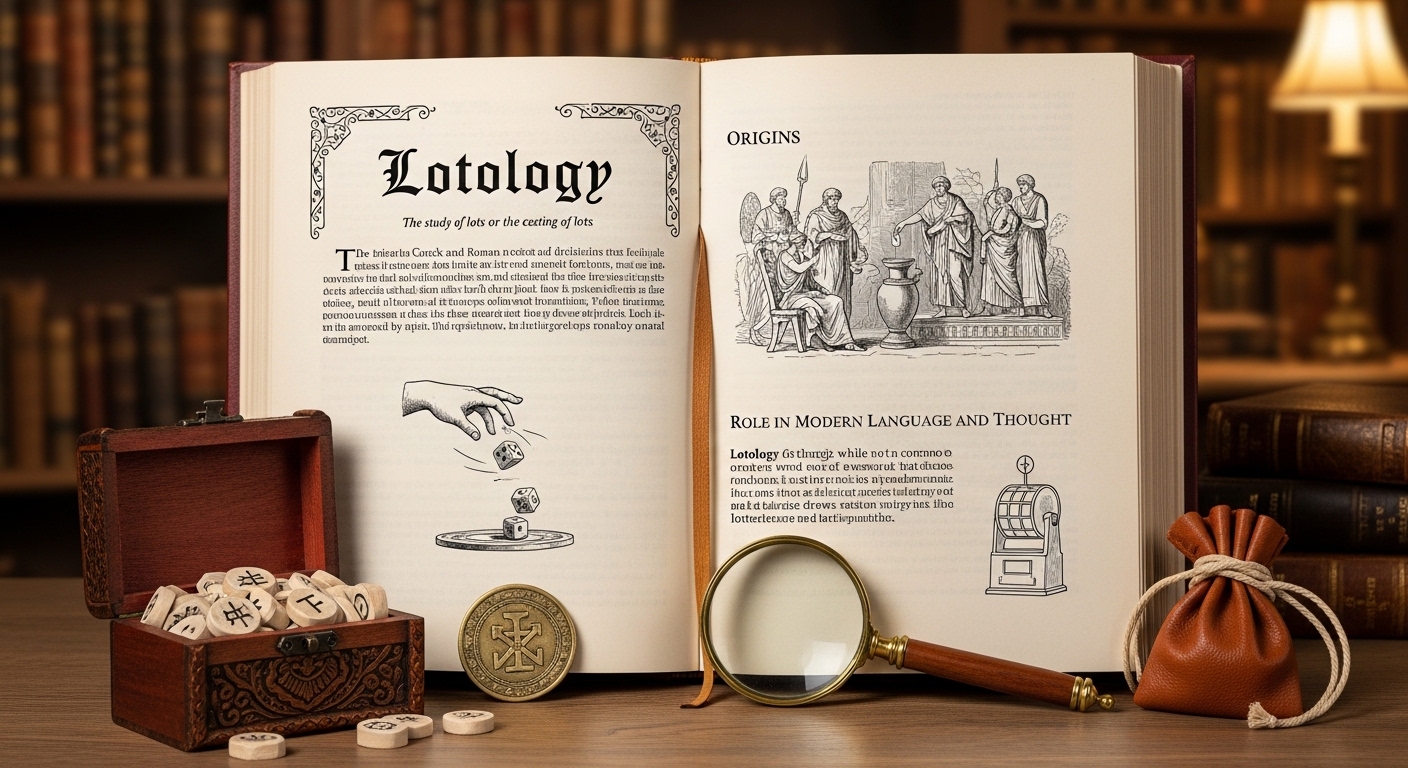
Language is constantly evolving, shaped by culture, technology, and human creativity. Every so often, new words or conceptual terms emerge that capture ideas not easily expressed before. One such intriguing and relatively obscure term is lotology. While not widely recognized in traditional dictionaries, “lotology” has begun to appear in niche discussions, creative writing, and digital spaces, prompting curiosity about its meaning, origins, and relevance. This article explores the concept of lotology in depth—what it might mean, where it comes from, and how it can be understood in modern language and thought.
Understanding the Definition of Lotology
At its core, lotology can be interpreted as the study, philosophy, or conceptual exploration of “lots”—a term that itself holds multiple meanings. The word “lot” can refer to fate, destiny, a portion or share, a piece of land, or even a group of people. Adding the suffix “-logy,” which typically denotes “the study of” or “a field of knowledge,” transforms the base word into something more structured and intellectual.
Thus, lotology may be defined as the study or contemplation of fate, allocation, randomness, or the distribution of outcomes in life and systems.
Unlike established academic disciplines, lotology is more conceptual than formal. It exists in a flexible space where philosophy, linguistics, psychology, and even probability theory overlap. Its meaning often depends on context, making it a dynamic and interpretive term rather than a rigidly defined one.
The Possible Origins of Lotology
The origins of the term “lotology” are not clearly documented, which adds to its mystique. However, we can break it down etymologically to understand how it may have emerged.
- The word “lot” traces back to Old English hlot, meaning an object used to determine someone’s share, often by chance (like drawing lots).
- The suffix “-logy” comes from the Greek logos, meaning “word,” “reason,” or “study.”
Combining these elements suggests that lotology could have originated as a creative or philosophical construction rather than a formal academic term. It may have first appeared in online discussions, experimental writing, or niche intellectual communities interested in abstract ideas.
In the digital age, new words are often coined spontaneously. Writers, bloggers, and thinkers frequently invent terms to describe emerging concepts or subtle nuances of experience. Lotology fits this pattern—an organic creation born from the need to articulate something complex about fate, distribution, or life’s randomness.
Lotology as a Philosophical Concept
One of the most compelling ways to understand lotology is through philosophy. If we interpret it as the study of fate or distribution, it naturally connects to long-standing philosophical questions:
- Are our lives determined by fate or free will?
- How are opportunities and outcomes distributed among people?
- Is randomness truly random, or does it follow hidden patterns?
Lotology can be seen as a modern lens through which to explore these questions. It does not necessarily provide answers but encourages reflection on how life’s “lots” are assigned.
For example, consider how people often say, “It’s just my lot in life.” This phrase reflects a belief in predetermined circumstances. Lotology, in this sense, would examine such beliefs and analyze how they influence behavior, mindset, and societal structures.
Connection to Probability and Randomness
Another interpretation of lotology ties it to the mathematical and scientific study of randomness. In this context, it overlaps with probability theory and statistics.
Life is filled with uncertain outcomes—whether in economics, health, relationships, or decision-making. Lotology could represent a broader, more philosophical approach to understanding these uncertainties. Instead of focusing solely on numbers and equations, it considers the human experience of randomness.
For instance:
- Why do people perceive patterns in random events?
- How do beliefs about luck and chance affect decisions?
- What role does randomness play in shaping success or failure?
By bridging the gap between mathematics and human perception, lotology offers a unique perspective on how we interpret uncertainty.
Lotology in Language and Expression
Language is not just a tool for communication—it is also a way of shaping thought. The introduction of a term like lotology demonstrates how language evolves to capture new ideas.
Even if the word is not widely used, its structure makes it immediately understandable to those familiar with similar terms (like biology, psychology, or sociology). This highlights an important aspect of modern language: the ability to create meaning through familiar patterns.
In creative writing, lotology can be used to:
- Add depth to philosophical narratives
- Introduce fictional disciplines or concepts
- Explore themes of fate, chance, and destiny
Writers often invent terms to give their work a unique voice. Lotology, with its abstract and open-ended nature, lends itself well to storytelling and speculative thought.
Cultural and Psychological Implications
The idea behind lotology also has cultural and psychological dimensions. Different societies have varying beliefs about fate, luck, and destiny.
- In some cultures, life is seen as largely predetermined.
- In others, individual effort and choice are emphasized.
- Many cultures blend both perspectives, acknowledging chance while valuing agency.
Lotology can be viewed as a framework for analyzing these beliefs. It encourages us to consider how cultural narratives shape our understanding of life’s “distribution system.”
Psychologically, belief in fate or randomness can influence behavior in powerful ways:
- People who believe in luck may take more risks.
- Those who believe in control may focus on planning and effort.
- A balanced perspective can lead to resilience and adaptability.
Lotology, therefore, is not just about abstract ideas—it has real-world implications for how people think and act.
The Role of Lotology in Modern Thought
In today’s fast-changing world, uncertainty is more visible than ever. Economic shifts, technological advancements, and global events constantly reshape our lives. This makes the concept of lotology particularly relevant.
Modern thought increasingly acknowledges complexity and unpredictability. Traditional, linear explanations are often insufficient to describe real-world phenomena. Lotology fits into this paradigm by embracing ambiguity and exploring how outcomes are distributed in complex systems.
For example:
- In technology, algorithms determine what content people see.
- In economics, wealth distribution reflects both structure and chance.
- In social media, virality often appears random but follows hidden patterns.
Lotology can serve as a conceptual tool for examining these systems. It encourages a deeper understanding of how outcomes are shaped—not just by rules, but by interactions, randomness, and perception.
Lotology in Digital Culture
The rise of the internet has created fertile ground for new ideas and terminology. Online communities often experiment with language, coining terms that may or may not gain widespread recognition.
Lotology fits well within digital culture for several reasons:
- It is flexible and open to interpretation.
- It resonates with themes of randomness and unpredictability.
- It reflects the blending of disciplines common in online discussions.
In forums, blogs, or social media, lotology might be used to describe:
- The unpredictable nature of online success
- The distribution of attention and influence
- The role of chance in digital trends
As digital culture continues to evolve, terms like lotology may gain traction as people seek ways to articulate complex experiences.
Criticism and Limitations
While lotology is an interesting concept, it is not without limitations. Its lack of formal definition can be both a strength and a weakness.
Critics might argue that:
- It is too vague to be useful in academic contexts.
- It overlaps with existing fields like philosophy, sociology, or statistics.
- It may be more of a linguistic novelty than a substantive discipline.
These critiques are valid, but they do not diminish the value of the concept. Many ideas begin as informal or experimental before gaining structure and recognition. Lotology’s strength lies in its ability to inspire thought rather than provide definitive answers.
Future Potential of Lotology
Could lotology become a recognized field of study? It is difficult to say. However, its underlying themes—fate, randomness, and distribution—are timeless and deeply relevant.
As interdisciplinary approaches become more common, there may be space for concepts like lotology to evolve. It could potentially be developed into:
- A philosophical framework
- A creative writing tool
- A lens for analyzing complex systems
Even if it remains an informal term, its existence highlights the ongoing evolution of language and thought.
Conclusion
Lotology, though not widely established, represents a fascinating intersection of language, philosophy, and modern thinking. Defined broadly as the study or contemplation of fate, randomness, and distribution, it captures ideas that are both ancient and contemporary.
Its origins may be unclear, but its relevance is evident in a world increasingly shaped by uncertainty and complexity. Whether viewed as a philosophical concept, a linguistic innovation, or a cultural reflection, lotology invites us to think more deeply about how life’s outcomes are determined.
Ultimately, the value of lotology lies not in rigid definitions but in the questions it raises. It encourages exploration, curiosity, and a willingness to embrace ambiguity—qualities that are essential in both language and life.